Sunday, August 23, 2015

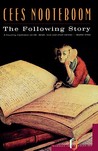
The Following StoryThe Following Story by Cees Nooteboom
My rating: 5 of 5 stars

"We will feel the draft blowing through the cracks in the structure of causality"

Is there such a thing as an impossibly beautiful book? Probably not, but Cees Nooteboom's "The Following Story" comes awfully close. So close that when I had finished reading the novella, I immediately read it again. It might not resonate with everybody, though: past a certain age, one subject tends to preoccupy one's mind, and Mr. Nooteboom writes, beautifully, about that subject. So while a younger reader will be likely to ask "What is that all about?", those of us who are almost there, will know.

This short novella has two distinct parts: In "One" Herman Mussert, a teacher of Latin and an author of cheap travel guides, tells us how having gone to sleep in Amsterdam, he wakes up in a room in Lisbon, the same room where he had made love to a woman many, many years ago. We do not know which "he" he is, though: the "he of then" or the "he of now"? The structure of causality is drafty indeed. What is "now", by the way? Where is it where it is not here any more? And what is "I"? Am I the same I as 20 years ago?

In the dreamlike and hypnotic "Two" Mr. Mussert is on a ship traveling across the ocean, into the mouth of the Amazon river, close to the city of Belém on the Brazilian coast, and then up and up the river, past Manaus and the Rio Negro junction, surrounded by the nocturnal jungle. The ship passengers take turns to tell stories of their lives and then they quietly disappear, one by one, never to be seen again. Mr. Mussert is waiting for his turn.

The two parts, so remarkably different, need each other: the second would not make its tremendous impact without the first; the first without the second would just be a philosophical discourse on causality and passage of time. What makes this book so powerful is that its ostensibly main theme - our impermanence - is not the dominating one; "The Following Story" is also about love in its multitude of forms: love for beauty, as in poetry of Ovid, love for a student who shares the teacher's zeal in the quest for truth and knowledge, love for Socrates' courage of convictions, and - of course - Mr. Mussert's love for Mrs. Zeinstra.

The translation is extraordinary; I do not believe the prose of the original could be any more luminous and delightful. The one problem with "The Following Story" is that after reading it most other books will seem like empty tales "told by an idiot, full of sound and fury, signifying nothing."

Five stars.


View all my reviews

Thursday, July 9, 2015

Iron Curtain : The Crushing of Eastern Europe, 1945-1956Iron Curtain : The Crushing of Eastern Europe, 1945-1956 by Anne Applebaum
My rating: 5 of 5 stars

Being a Pole I am lucky to have been born several years after the end of World War II. I was spared the unspeakable horrors and atrocities committed by Germans during the war and occupation. I was also spared the horrors and atrocities that accompanied the Russian liberation of Eastern Europe and were still happening behind the Iron Curtain during the first 10 or so years after the war. My first memories that relate to politics date to 1956, which was the year demarcating the terrible period of High Stalinism and the tough-but-not-all-that-dreadful times of late 1950s to early 1980s.

Anne Applebaum's "The Iron Curtain: The Crushing of Eastern Europe: 1944-1956" is a monumental work, meticulously and exhaustively researched (almost 70 pages of references), well written and compulsively readable; in addition I have found it tremendously illuminating. Based on what my family and older friends had told me about the 1940s and 1950s I can see how historically accurate the text is. At the same time I have learned so much about an important period in my native country's history.

The book is divided into two parts: "False Dawn" which deals with the years from 1944 to 1948 - the years of liberation from German occupation and subsequent enslavement by the Soviet ideology - and "High Stalinism", which investigates the 1949 - 1956 period. The author focuses on three countries that were undergoing the process of "Stalinization": Poland, Hungary, and East Germany (the so-called "German Democratic Republic"). Historically and socially, the countries are quite different, yet the fates they suffered in that gruesome period are very similar.

"The Iron Curtain" offers a broad panorama of the times and utilizes a wide array of angles of view. The individual chapters illustrate various aspects of the process of "Stalinization": the Communist leadership, the security apparatus, the armed anti-Communist opposition, massive ethnic cleansing, the indoctrination of youth, the role of radio (the main mass media at the time), the so-called free elections and referendums, the nationalization of industry, the role of small business, the persecution of church and the religion's role in leading the resistance, the show trials, the elimination of all civic and social institutions, the creation of homo sovieticus, the so-called "socialist realism" dictate in arts and culture, the reluctant collaborators and passive opponents of the system, and finally the revolutions against Stalinism, which began in 1953 and culminated in 1956.

While Ms. Applebaum's work - she is a Pulitzer Prize winner for her "Gulag", and in my view she deserves another award for the "Iron Curtain" - is extremely thorough and rich in detail, the best feature, to me, is its structural concept: interweaving the serious historical study approach with deeply resonant personal stories of people. It is yet another testimony to the quality of the author's work that various reviewers identify different central themes of the book. The motif that resonates with me the most is one that the author mentions at the end of the Introduction "I sought to understand how ordinary people learned to cope with the new regimes, [...] how they came to make terrible choices the most of us in the West, nowadays, never have to face." The motif of ordinary people, present throughout the entire book, forcefully appears close to the end, where Ms. Applebaum writes about "the system's ability to get so many apolitical people in so many countries to play along without much protest".

As a pragmatist and an ideology skeptic I have been particularly impressed by the story of Wanda Telakowska of the Ład group, a "reluctant collaborator", a true positivist, who worked very hard - and successfully! - to preserve the notions of beauty and harmony in art design for mass-produced items despite the then prevalent grim model of socialist realism. She managed to convince the "Sovietized" people at the top of power hierarchy that reconstructing Polish culture after the war was an important goal.

It took me way over a month to read the book as I read every single sentence with full attention. I needed to know about that horrible period. I owed it to my parents, grandparents, and all the people who had to suffer so much. I had an obligation to learn about those times and tell that to others. "The Iron Curtain" should be a mandatory reading to help people understand how totalitarianism works, how dangerous an ideology can be, how easy it is to mislead millions and millions of people and how it is possible that even after almost everybody quits believing, an ideology can thrive for long years.

Four and three quarter stars.


View all my reviews

Tuesday, June 9, 2015

SummertimeSummertime by J.M. Coetzee
My rating: 5 of 5 stars

"Summertime" (2009) is the final part of J.M. Coetzee's fictionalized autobiography: it completes the trilogy that began with "Boyhood" and "Youth" . In the first two books Coetzee refers to himself in the third person, as a "he". Here he goes even further - "Summertime" is narrated by an English academic, a Mr. Vincent, who is working on Coetzee's biography, after the author has died. There is no doubt that the deceased John Coetzee, the subject of Mr. Vincent's biography, is the very same J.M. Coetzee, who created Mr. Vincent's character, and who - fortunately for us - is still very much alive and active as a writer. Henceforth, I will refer to fictionalized Coetzee as JC, to distinguish him from the "real" J.M. Coetzee.

The book is composed of five interviews with people, mostly women, who knew JC well in the early and middle 1970s in South Africa, and it is bracketed with undated fragments from JC's notebooks. I find the first three interviews totally spellbinding. Dr. Julia Frankl, born Kiš Julia of Szombathely, Hungary, used to be JC's lover. Margot is JC's cousin, who shared childhood with him. Finally, Adriana Nascimento, a Brazilian dancer, is the mother of a teenage girl whom JC taught poetry. We learn a lot about JC from these interviews but we learn even more about the three women - the stories are masterpieces of characterization and they make me feel I have known these women for a long time. Some critics opined that J.M. Coetzee cannot create strong female characters. Nonsense!

Julia talks vividly about her affair with JC and portrays him as a man who has no ability to connect with other people. He is like "the man who mistook his mistress for a violin." Margot, the cousin, tells many wonderful stories from their common childhood, and the account of them going to Merweville in a car that needs fixing is beautifully told. Adriana, a mother who knows very little about raising her daughters yet thinks she knows a lot, claims she was the target of JC's affection. Each of the three stories would make a fabulous novella.

In contrast, the two latter interviews, with JC's colleagues from the university in Cape Town, where he taught, are exclusively about him: both Martin and Sophie are virtually transparent - they serve solely to convey JC's views, beliefs, and motivation. Let me point out two main themes that may help us better understand JC (and by extension J.M. Coetzee). The first is summarized by Mr. Vincent: "What Coetzee writes [...] cannot be trusted, not as a factual record - not because he was a liar but because he was a fictioneer. In his letters he is making up a fiction of himself for his correspondents; in his diaries he is doing much the same for his own eyes, or perhaps for posterity." Can recursion in literary arts go any further? J.L. Borges often played with recursion, but his are rather formal games. In "Summertime" we have J.M. Coetzee writing about how JC's writings about himself cannot be quite trusted, we have the "real" author's fiction about how the author's literary double fictionalizes the events of his life. Magnificent!

The other theme will undoubtedly be considered more important by J.M. Coetzee readers (not by me, though.) Why hasn't he been more active in condemnation of apartheid? Why has he tried to right the wrongs only through literary means? Sophie explains to Mr. Vincent that JC was not apolitical but rather "anti-political". And there comes one of the most astute fragments of the book "In Coetzee's eyes, we human beings will never abandon politics because politics is too convenient and too attractive as a theatre in which to give play to our baser emotions. Baser emotions meaning hatred and rancour and spite and jealousy and bloodlust and so forth. In other words, politics is a symptom of our fallen state and expresses that fallen state."

At the end of her interview, Sophie gives a sharp summary of who JC really was. I will not quote the powerful fragment but I strongly recommend the last two paragraphs of that interview to anybody interested in understanding J.M. Coetzee's work.

The second set of "Undated notes" contains a profoundly sad passage about an incident from JC's youth which illustrates the complicated relationship he had with his father. It brought tears to my eyes, and I would like it to become mandatory reading for everybody, especially for parents and their grown-up children.

I was quite reluctant to read "Summertime": I figured that writing about oneself via stories told by other people is a form of narcissistic self-gratification, yes, extremely refined, but still a masturbation of sorts. I was wrong - this is yet another great book from one of the greatest contemporary writers. I am heaping all this praise despite one two-sentence fragment, which sounds like it was written by a bestseller writer rather than a real one: "His father opens his eyes. Generally he is sceptical about the capacity of the ocular orbs to express complex feelings, but this time he is shaken." A case of truly horrible, jarring periphrasis. I almost believe J.M. Coetzee is teasing the reader "Look, I can write crap as well as all other crap authors."

Finally, deep thanks to the author for "liquefaction". If not for "Summertime" I would not have had a chance to read an absolutely outstanding poem by Robert Herrick, written almost 400 years ago, whose first stanza is:

Whenas in silks my Julia goes,
Then, then (methinks) how sweetly flows
That liquefaction of her clothes.


Four and three quarter stars.


View all my reviews

Saturday, May 23, 2015

Under the FrogUnder the Frog by Tibor Fischer
My rating: 5 of 5 stars

Tibor Fischer's "Under the Frog" was shortlisted for the prestigious Booker Prize (the best original novel written in the English language) in 1993. Indeed it is an extraordinary book - powerful, often tragic and hysterically funny. It is advertised as a "black comedy" - well, maybe; life in general might be viewed as a black comedy, considering the futility of human efforts in the face of the guaranteed unhappy ending. Salman Rushdie offers a blurb for the cover: "A delicate, seriocomic treasure." True, but let's clarify that the comic element comes from the writing. While many issues addressed in the novel - deprivation, suffering, death - are not quite that funny, Mr. Fischer's prose is absolutely, totally hilarious.

The novel tells the story of Gyuri Fischer and several friends of his, basketball players, against the backdrop of dramatic events in Hungary between 1944 and 1956, covering the period from the end of German occupation, through the so-called liberation by the Soviet troops, which brought Russian occupation, to the hard years of Rákosi Stalinist regime, until the novel culminates in unforgettable scenes from the failed Hungarian uprising of October 1956.

The depiction of the October uprising in Budapest is astounding in its sheer power. The revolutionary fervor of ordinary people, the chaos and randomness of street fighting, people throwing petrol bottles at Russian tanks, moments of revenge on hated Hungarian security agents, led to tops of high buildings to practice their flying skills. The days of freedom, hope, joy, and death.

The book may take some effort to understand for readers who never lived in a totalitarian regime, where 99.9% of the society are completely against the government, yet nothing can be done about it as most people naturally prefer to live enslaved than die hero deaths or linger in prison. Over half a million of Hungarians were imprisoned, executed, or sent to Russian labor camps, after the "liberation" of this small country. Those who did not actively oppose the government were allowed to live in a Communist heaven, where people pretended to work and the government pretended to pay them, with virtually the entire economy being underground, and grocery stores carrying only two items: pickled gherkins and apricot conserve.

The picture painted by Mr. Fischer is frightfully accurate. The conditions in Poland, my native country, were not as drastic as in Hungary and not as many people perished in Stalinist times, but the grim atmosphere of oppression was the same, and the Polish people enthusiastically celebrated the Hungarian uprising of 1956. These October days are my first memories connected with politics. I recall demonstrations in support of Hungarian freedom fighters, and the blood drives to help thousands of victims. My life was so much easier though - I am about 20 years younger than Gyuri, I missed the war and the Stalinist period, and conditions after 1956 were quite benign both in Hungary and Poland, with Communism showing its "human face".

An outstanding novel, exceptionally well written. Sad and funny to tears.

Five stars.


View all my reviews

Saturday, April 25, 2015

His Master's VoiceHis Master's Voice by Stanisław Lem
My rating: 5 of 5 stars

This extraordinary novel from the favorite writer of my youth, Stanisław Lem, defies categorizations. While on the surface it is a suspense novel or a "mystery" (more precisely, a scientific and philosophical mystery/suspense), it is actually more of a treatise on the human species' place in the Universe. Mr. Lem, who began in 1940s as a science-fiction writer and became the world's most widely read science-fiction author, left his mark on the 20th century as one of the deepest thinkers writing about science, technology, and the future of human race. He was a philosopher, serious futurologist, humanist, and popularizer of science. "His Master's Voice" (Polish title "Głos Pana") is one of his first "serious" books, and definitely my favorite. I read it for the first time in 1968, immediately after it had come out, and loved it. I have now re-read it, and it is still one of the most enthralling books I know and certainly one of the most thought-provoking.

The events described in the novel take place in the near future. A non-random, repeating pattern has been discovered in a neutrino stream recorded by astrophysicists at the Mount Palomar observatory. American government establishes a secretive project, dubbed "His Master's Voice", aimed at deciphering the "message from the stars". After a year of work, with the scientists no closer to understanding the message, new people are recruited to the project. A famous mathematician, Peter Hogarth, who is the narrator of the story, is among them. Dr. Hogarth is able to prove that the message has a topological property of "closure", which indicates that it is an object (a thing or a process) separate from the rest of the world. In the meantime, the project's biochemists and biophysicists manage to translate fragments of the message into physical substances that exhibit unusual properties. Perhaps most interestingly, it is discovered that the particular structure of the neutrino stream helps in creating the configurations of molecules that constitute the chemical backbone of life, and thus that the message increases the probability of creation of life.

However, let's not forget that the project is largely controlled by the military who are hoping that the message will help construct some kind of super-weapon. Of course, their argument is that the other side (the novel was written in the times when there were just two superpowers - the U.S. and the Soviet Union) is probably also working to decipher the message and convert its contents into a super-weapon. I will not divulge how this subplot develops, but it is extremely successful in portraying the mechanisms of arms race, and the denouement is - I am sorry for using big words but they fully belong here - phenomenally clever. Neither will I divulge the overall conclusion of this scientific suspense novel - it is absolutely credible and it uniquely fits the premise. Find it for yourself!

I am sort of a mathematician, albeit not a very good one, no wonder then that I totally love Mr. Lem's presentation of differences between mathematics and social sciences - I was laughing for an entire day having read how Dr. Hogarth's results were not recognized by social scientists working on the project because his "style of thinking [...] provided no scope for rhetorical counterargument". Hilarious! On the other hand, Mr. Lem expertly shows the natural arrogance of a mathematical genius, who knows that the statements he has proved will always remain true, regardless of current political trends and prevailing philosophy.

When I came back to this book after 47 years, I expected I will find it dated and full of obsolete references. Amazingly, this is not the case at all. Written in pre-Internet times, "His Master's Voice" reads like an absolutely contemporary novel; it could have been written last year. The translation from Polish by Michael Kandel is superb.

I have left what is the best for me for last - "His Master's Voice" does not read like fiction. It makes the reader feel this is a chronicle of actual events, something like the story of Manhattan Project from the 1940s or any other big-scale scientific project. Several times, when reading the novel, I caught myself thinking the events have actually happened, and I had to forcefully remind myself that what I was reading was only fiction.

Trying to maintain balance, I need to mention that I do not like the Preface and the first chapter. They are a little overwrought and pompous, which makes me chip a quarter of a star off the rating for this masterpiece.

Four and three quarter stars.


View all my reviews

Sunday, March 29, 2015

Zappa: A BiographyZappa: A Biography by Barry Miles
My rating: 5 of 5 stars

Frank Zappa is the musical idol of my youth. I listened to Zappa's album "Freak Out!" almost 50 years ago, in 1966 or 1967, fascinated by what I considered the avant-garde freshness of the music, political references, and great sense of humor. Obviously, being a teenager, I dearly loved the scatological and obscene references. Later, when I tried to grow up, came my fascination with Mr. Zappa's strong stance for freedom of speech and against consumerism. As far as music is concerned I was very much into Mr. Zappa's guitar playing, and "Hot Rats" and "Shut Up n' Play Yer Guitar" were some of my most revered albums. Zappa's death in 1993 came as a big loss in my life. Zappa had been my hero, someone to look up to politically and musically.

I read (or tried to read) several books about my hero. Zappa's autobiography - "The Real Frank Zappa Book" - made me adore my idol even more. I did not particularly like the unfocused "The Frank Zappa Companion", and could not very much get into "Frank Zappa: the Negative Dialectics of Poodle Play, full of technical details about the music, and sounding too much like a research paper on the conceptual continuity of Zappa's work for my taste. I have just now finished "Zappa" by Barry Miles. It is a great biography, a serious, extremely well researched book that - in my view - does a fantastic job of showing the real Frank Zappa - a musical giant, yet a real person, full of insecurities and obsessions. A genius yet also somewhat of a jerk.

The major strength of Mr. Miles' biography is that it transcends the biographical details, the enumeration of albums, songs, and performances, and the trite gossip. The author proposes several theses about forces that drove Frank Zappa in his art and in life and provides convincing arguments for these theses. Perhaps the most important of them is that the experience that shaped the artist the most was the ten days he had to spend in San Bernardino County Jail for making an ostensibly pornographic tape, whereas in reality he was entrapped by a zealous policeman. "By the time he got out, he no longer believed anything the authorities had ever told him. Everything he had been taught at school about the American Way of Life was a lie." Ever from then on he would try to make America "see itself as it really was: phoney, mendacious, shallow and ugly."

Zappa often claimed he did not want to become what he is known to most people as - a rock musician. He famously confessed "I never had any intention of writing rock music. I always wanted to compose more serious music and have it performed in concert halls." His becoming one of the most famous rock artists was a vehicle that allowed him achieve his ultimate goal - having various symphony orchestras play his "serious" compositions. The guise also allowed Zappa to achieve the other major goal of his life - becoming a pre-eminent social critic. Songs like Brown Shoes Don't Make It express "consummate indictment of government corruption and the vacuous sterility of American consumer society." In I'm the Slime Zappa "describes television content as vile and pernicious, brain-washing the American public until they are a country of zombies who do as they are told: eat the processed junk food that is advertized, and think what the government wants them to think, all dished up as mind-numbing sit-coms, soap operas and game shows." Well, it is hard not to totally agree with this assessment.

Mr. Miles' diagnosis is most acute when he emphasizes Zappa's "ambivalent relationship to the counter-culture". While living in the absolute center of this counter-culture, he despised most of what it stood for. Zappa usually had very little respect for his fans and often he even vilified his audiences. He treated many people whose money he took for performing for them like complete idiots (and rightly so). The famous "Gee, my hair's getting good in the back!" quote satirizes the audiences' preoccupation with looking like the band members they idolized. The adolescent boys screamed in delight when they listened to Zappa's famous Titties and Beer, which was, basically, a song about how stupid they were.

I am for complete freedom of speech in arts and do not mind if an artist wants to write songs with lyrics about defecation, urination, flatulence, feet odor, nasal excretions, and other such things. People who are disgusted by the subject matter should just refrain from listening to these songs. And yes, I am disgusted with some Zappa's lyrics - I think 'Jazz Discharge Party Hats' might be the grossest song ever - yet I still support his right to write such a song, while at the same time doubting whether he ever managed to grow up.

What Mr. Miles' book made quite clear to me is how tyrannical and callous Frank Zappa was with respect to the musicians who played for him. Despite the fact that they had to work extremely hard - no other bands in the history of rock had to practice that hard during insanely prolonged rehearsals - and that Mr. Zappa paid them little, he continuously berated them and fired at will. His patronizing remarks about the members of the London Symphony Orchestra, who played his compositions and applauded his skills as a composer, are a particularly acute example.

Mr. Miles puts forward several other interesting theses in his book, for instance, about the influence of Zappa's Sicilian patriarchal roots, the consequences of his father's constant job changes and consequent relocations of Zappa's family, his lack of friends, even his apparent inability to love, yet this review is already way overlong. To sum up (finally!): Frank Zappa is a great musician and a keen social observer. He is the author of perhaps my favorite epigram "Scientists claim that hydrogen is the basic building block of the universe because it is so plentiful. I say there is more stupidity than hydrogen, and that is the basic building block of the universe." Yet, there is also another side to the genius and while I still admire Frank Zappa, I would somehow feel embarrassed, having read this great biography, to call him my hero.

Four and three quarter stars.


View all my reviews
Wednesday, February 18, 2015

A Long SilenceA Long Silence by Nicolas Freeling
My rating: 5 of 5 stars

"His wife's smile, and the smell of mimosa vividly pictured and for one instant recaptured, would be the last thing in his life. That, and the moisture on his loden coat, and the dead leaves, and a wet leather glove: the smells of Holland."

Nicolas Freeling's "A Long Silence" (also published as "Auprės de ma Blonde") is the most extraordinary crime novel I have ever read. I do not really mean the best one - some weaker spots can be found - but I challenge anybody to find a more unusual mystery. Let's see:

This is the ninth novel in the series featuring Piet Van der Valk, first an inspector, finally a Principal Commissary of the Dutch police. Well, there is no tenth book in the series as he is killed while conducting a private investigation. In the remainder of the novel, it is Arlette, Van der Valk's widow, who is the principal character, and who completes the investigation. Sherlock Holmes also dies in one of Conan Doyle's stories, but he gets resurrected later. Nicolas Freeling is cooler than that; he knows that death is irreversible. I love Van der Valk, but I totally admire Mr. Freeling's courage for doing away with the protagonist of his series, and I just wish authors of other series would do the same.

When Van der Valk dies, Mr. Freeling, the author of the novel himself, appears in the novel. The author's emergence is seamlessly woven into the story. There is not a single false note in this meta-fiction experiment.

Finally, and most importantly (at least to me), the first 80+ pages of the novel are exceptionally well written. I do not mean "well written for a crime novel". J.M. Coetzee, James Joyce, or any other great author could not write better than that. It is high-class literature, simply breathtaking. Nothing is said to the end, things are just hinted at, exactly as in real life, where we just think we understand what is going on. Also, Larry Saint is one of the most vividly drawn characters in world literature.

The remainder of the novel is perceptibly weaker - the whole concept of a group of amateurs planning revenge is rather ridiculous. There are too many dialogues, whereas Mr. Freeling is an absolute master of narrative prose. I also find the ending disappointing. Still, the weaknesses of the latter part only accentuate the absolute greatness of the first third of the novel.

Four and a half stars.


View all my reviews