Wednesday, March 26, 2014

A Month in the CountryA Month in the Country by J.L. Carr
My rating: 5 of 5 stars

Although J.L. Carr's "A Month in the Country" was published in 1978, it reads like a classic. It is an enthralling novella of What Might Have Been. People who are on the descending path in their lives, like myself, will understand it better than the young ones. We do not have any future; we only have the past. Most of what we have are the memories of the good times long time gone and we often think of what might have been if we did things differently.

It is the hot August of 1920. Tom Birkin, a World War I veteran is hired to restore a whitewashed, several-hundred-years old mural in a Yorkshire parish of Oxgodby. He meets another veteran, Charles Moon, who has been hired to find remains of a 14th-century character in the same parish. Tom also befriends the stationmaster's young daughter and the vicar's wife,

It is just about a month in the country, but viewed from the perspective of fifty or so years later, the month is a tremendous turning point. What might have been if we did things differently. How totally different our life would be if we just said one word or moved our arm in a different way.

An exquisite fragment of prose can be found here (but it is a kind of a spoiler).

A beautifully written book. A masterpiece of English prose. One of the best books I have read in my life.

Five stars.


View all my reviews

Saturday, March 8, 2014

DisgraceDisgrace by J.M. Coetzee
My rating: 5 of 5 stars

J.M. Coetzee's "Disgrace" is the first so-called "serious" book I have read in quite a long time (although some of the mysteries are serious literature in their own right). It is a stunningly well-written book, beautiful yet very painful to read - not because of scenes of violence or abuse, but because it is unrelenting in showing truth about people and their wretched lives.

David Lurie, a writer and a communications professor at the Cape Technical University, has an affair with a young woman, one of his students, and is forced to leave his job in disgrace. He moves to his daughter's smallholding in Eastern Cape and tries to adapt to rural life, helping with farming chores and with euthanizing animals in a rescue center. Soon, David and his daughter are subject to a violent act, rooted in racial conflict in the post-apartheid South Africa. This brief and simple synopsis of the beginning of the plot is quite misleading; so many issues are touched in this short book that a literary critic could write an essay based on every single page of the novel. An attempt of mine to review the depth and complexity of this book would be ridiculous - it would be akin to a grade-school student discussing a unified field theory.

The novel is rich in unforgettable scenes. The university inquiry into David's affair is superbly portrayed, and the animal euthanasia scenes are gut-wrenching. One could fill quite a collection of quotes with acute observations like "nothing so distasteful to a child as the workings of a parent's body" or "the proper business of the old: preparing to die". Mr. Coetzee is a virtuoso writer, and I wish I did not have the mystery-novel-related habit of fast reading, so that I could savor the writing and the language.

This extraordinary novel offers no message. There is no closure, no redemption. There is life and its continuity of hope and suffering, of death and birth.

Five stars.


View all my reviews
The Crying of Lot 49The Crying of Lot 49 by Thomas Pynchon
My rating: 5 of 5 stars

Thomas Pynchon's "The Crying of Lot 49" (published in 1966) is an absolutely unique book. This is my first complete Pynchon's novel; I have read large fragments of "V" and "Gravity Rainbow", but even if I have totally loved the writing I have never finished those as I detest books longer than 200 or so pages. "The Crying" is only 138 paperback pages long yet it took me about 12 hours to read the novella. I can read 1000 pages of lesser authors in 12 hours. Almost on every page of "The Crying" there are sentences and passages so fascinating that I have to keep rereading and rereading.

The plot of this novella takes place in 1964 or so. Oedipa Maas is named the co-executor of the will of her recently deceased ex-lover, Pierce Inverarity. While trying to discharge her executor's duties she becomes aware of a historical mystery - she learns about an ancient postal delivery service, the Trystero, that used a characteristic muted post horn symbol. The service was vanquished in early 1800's by Thurn-und-Taxis Post, but went underground and has continued its existence since then. The premise is so ridiculously absurd that it presses all my "love of surrealism" buttons. Tradition of postal fraud dating back to 1206!

So Oedipa is looking for Trystero muted post horn signs and we are offered an incisive and funny portrait of California and Californians in the mid-Sixties, during the "British Invasion", and just before the great cultural revolution of 1968-1969. Pynchon's writing is extremely rich in social and cultural references. There are references to references to references, and the prose is labyrinthine and dense. Just as an example, in the space of half a page we learn about a nose-picking contest, electronic music, and about Czar Nicholas II of Russia dispatching his Far East fleet to San Francisco Bay.

Great authors create alternative worlds through their writing. The world created by Mr. Pynchon is exhilarating and fascinating. How can one not like KCUF, the name of radio station where Oedipa's husband, Mucho, works? How can a mathematician not love a passage on "DT", delirium tremens, that slowly morphs into "dt", an infinitesimally small increment of time in the foundations of calculus? The whole Courier's Tragedy shtick is superb. The bits about European history suggesting that maybe the French Revolution was caused by Trystero are hysterically funny. The passages that happen in the Bay Area read as extended hallucinations. Maybe Oedipa does indeed take LSD prescribed by Dr. Hilarius, despite her claims to the contrary?

Two favorite sentences from the novella - one for its sheer surrealism, the other for subtle beauty: "In Golden Gate Park she came on a circle of children in their nightclothes, who told her they were dreaming the gathering". And "As if the dead really do persist, even in a bottle of wine."

I have read that Mr. Pynchon himself does not consider "The Crying" an important book. Yet it is a gigantic, hilarious joke by a great writer. For me, with this novella, Mr. Pynchon is in literature what Rene Magritte is in visual arts. Post modern? What does "post-modernism" really mean? Will Professor Derrida's Gallic mumbo-jumbo illuminate me? I doubt it.

Four and three quarters stars.


View all my reviews
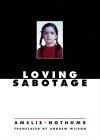
Loving SabotageLoving Sabotage by Amélie Nothomb
My rating: 5 of 5 stars

Amelie Nothomb's "Loving Sabotage" is an absolutely charming little book. It is an evocation of the author's childhood in Beijing (then called Peking) in the early Seventies and, at the same time, it is a damning critique of China of these times and a sharp study of human nature.

Ms. Nothomb's parents, both diplomats, are stationed in Peking along with diplomats from many countries, living in a restricted area (the 'ghetto'). All children roam the streets together and play an elaborate war game: the Allies versus the East Block embodied by the East Germans. The author writes in the first person - she is a seven year-old pathfinfder for the Allies. The war is quite cruel, yet wonderfully infantile (the yogurt enrichment episode and the unspeakable "monstrous act" made me laugh out hysterically). In addition to playing war games, the author also falls in love with a beautiful girl, and learns to play love games.

Ms. Nothomb presents a superb portrayal of childhood. Many people go through a stage of constructing alternative realities in their pre-teens. I know I did. The characterization of adults as "children fallen from grace" is stunning. There is plenty of tenderness and love in the book, and the narrator's comments written from the point of view of an adult complement the overall maturity and wisdom of the novel.

A fantastic read, sweet and light, yet deep. The translation by Andrew Wilson is great - it is hard to imagine the book could be any better in its original French.

The Afterword the author added in 2000 (the book was originally published in 1993) is unneeded. I think it slightly reduces the magnificent charm of the novel. Thus, instead of five solid stars, it is only

Four and three quarter stars.


View all my reviews
Waiting for the BarbariansWaiting for the Barbarians by J.M. Coetzee
My rating: 5 of 5 stars

If there were a contest for the most outrageous one-sentence summary of J.M. Coetzee's "Waiting for the Barbarians", my entry would be "Two main themes of the book are torture and an elderly man's sex life with young women". Although there is some truth in this flippant summary, I will rather be serious: it is really an allegorical novel about how power and fear degenerate people, and about some of the humanity's ugliest, shameful traits. I found this book almost as painful to read as the outstanding "Disgrace", yet the message, despite the allegory, is much more direct in "Waiting for the Barbarians".

The plot takes place in unspecified time in the past, in a town that is a far outpost of the (also unspecified) Empire. The magistrate, who narrates the story, holds judicial and executive powers. One of his main tasks is to keep in check the hordes of barbarian nomads who apparently roam nearby. They do not really do much harm to the Empire at this particular spot, yet the Third Bureau of the Civil Guard from the capital sends officers to the frontier town to take more drastic steps against the barbarians.

The visiting functionaries use the citizens' fear of barbarians to gain more power and use the power to instill more fear among the citizens. They catch barbarians and torture them, some to death. The magistrate, an old man, is a decent human being, yet he befriends a young woman, a victim of torture, and uses his power over her to have her as his servant and a warm, fresh body to worship and sleep with. This is just the beginning of the plot, which moves in unexpected directions, while always staying near the central issues of torture, power, and our (and our bodies') frailty in the face of oppression and physical pain.

I recall some literary critics explaining the novel as a commentary on the racial issues in contemporary South Africa (where Mr. Coetzee was born). I think they are wrong. The book is a commentary on the reasons why the human race will always struggle with racial issues, why we will exploit, torture, and execute THE OTHER people, whom we fear or, more accurately, whom we are taught to fear by people who have power over us.

Despite the ugliness of the subject matter, the book is beautifully written. I do not think that in my 50+ years of heavy reading I have encountered an author who writes better - more economically and with more clarity - than Mr. Coetzee. I am not sure which to praise more: the exquisitely masterful writing or the depth of the messages and the richness of threads. The novel has a poignant thread about a civilization that vanished and left hieroglyphic writings that are impossible to decipher. The quite prominent "erotic thread" makes this a very mature book; I do not think many people younger than middle age will be able to relate to this theme.

I will close this inept but heartfelt review with my favorite quote, which comes from the magistrate: "I should never have allowed the gates of the town to be opened to people who assert that there are higher considerations than those of decency".

Five stars.


View all my reviews
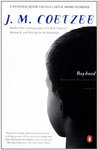
BoyhoodBoyhood by J.M. Coetzee
My rating: 5 of 5 stars

I find it amazing that there can be so much content in a 166-page book, and that the result is so spellbinding and perfect. J.M. Coetzee's "Boyhood: scenes from provincial life" is a portrait of the author as a 10-year-old boy growing up in South Africa. I have never read a more insightful analysis of a child's thinking and emerging personality; well, it is hard to find this level of psychological profundity in any writing. At the same time, the novel gives an amazingly rich and deep depiction of the South African society, with its class and racial divides.

Mr. Coetzee, in this "fictionalized autobiography" writes about a 10-year-old boy in the third person. The "he" is little John Coetzee, a precocious child, who loves and hates his mother and is ashamed of his father. The author reaches to the deepest and most private layers of a child's psyche, layers that one is usually too embarrassed to get to. One of the magnificent passages describes how the boy creates his first memories (yes, creates and edits them). The essential question are raised: Who am I? Where do I belong? As the author writes: "What he does not yet know is why he is in the world." The boy tries to figure out how the world works - who the good people are. He experiences something almost like the first love, and is fascinated by the beauty and mystery of other children's bodies.

The year is about 1950, just after the United Party's downfall and the ascent of the National Party rule. The boy lives in a society that is racially much more complex than that of the U.S. and probably of most countries in the world. The racial divides are between four distinct groups: the English, the Afrikaners, the "Coloureds", and the "Natives". Mr. Coetzee shows the racial fissures in the South African society sharply yet subtly. So many books in which the well-meaning authors try to present the problems of race on hundreds of crudely written and superficial pages read like predictable sermons. Here, the author writes four sentences about the meaning of the word "mustn't", and these four sentences perceptively convey the nature of racial inequality.

I can pleasantly waste about two hours of my life reading 166 pages of Connelly, Kellerman, or Grafton. I have spent about 12 hours over four days to read 166 pages of "Boyhood". These were some of the best spent 12 hours in my life.

Five stars.


View all my reviews
MischiefMischief by Chris Wilson
My rating: 5 of 5 stars

Chris Wilson's "Mischief" is one of the funniest books I have ever read. It attests to Mr. Wilson's literary skills that the book is hilarious while being nothing less than a philosophical treatise on the weaknesses and evils of human nature. To provide a sample of Mr. Wilson's writing and humor here is a fragment where he compares ideas and people: "Principles are precious, pure and brilliant; whilst people are dull and sordid [...] Which do you prefer - Truth, Art or your neighbour?"

Charlie, the narrator of the story, is found as a baby in Brazilian rain-forest by a British zoologist, Dr. Duckworth, who adopts him and takes him to England. Charlie learns that he is the last of the Xique Xique tribe. As he is almost hairless and orange-colored and as he seems to be developing at a slower rate than other people, he believes he is not a human being but rather a hominid creature, a different species than homo sapiens. Even so, he completes his university education, finds a job, and manages to succeed in quite a few sexual conquests. There is much more to the plot but it does not need to be divulged.

Charlie's special circumstances give him an opportunity to illuminate and condemn some of the worst vices of human race: hypocrisy, vanity, stupidity, affinity to violence, etc. "People - the hyenas of creation." is the most astute characterization of the human nature I have ever encountered. The "learned class", the academia, is the subject of especially biting satire, and rightly so. The novel is full of wisdom and despite its philosophical themes it is never boring. Clever word-plays and often outrageously funny humor make the book a pleasure to read.

It is a deeply unusual book, a one-of-a-kind gem. My thanks to the Complete Reviews website ( http://www.complete-review.com/main/m... ) for the hint.

Four and three quarter stars.


View all my reviews